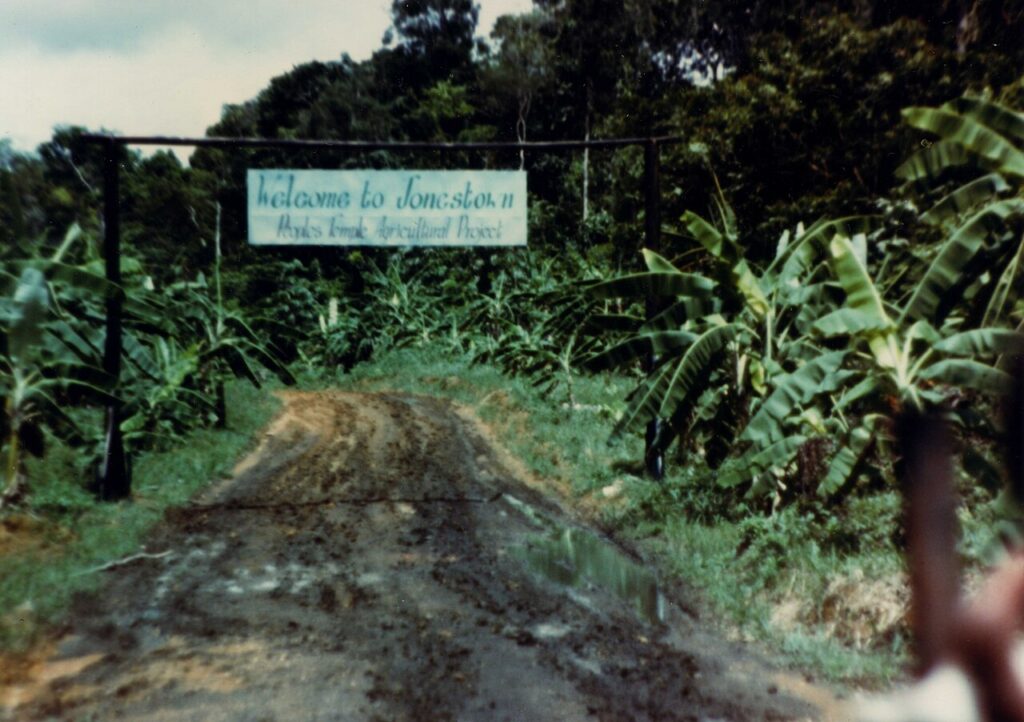
From the outset there seemed to be little mystery as to the facts of the case at Jonestown. The victims included over nine hundred men, women, and children of People’s Temple, the majority of them Black Americans from the San Francisco Bay Area (which matters). The scene of the crime was an agricultural commune in the South American nation of Guyana (not a coincidence). The murder weapon (the word “suicide” here would be imprecise) was a blend of poisons mixed into a powdered drink called Fla-Vor-Aid. The culprit was the Reverend Jim Jones and his motive was simple: to spare his flock their impending annihilation at the hands of the United States government. Jones had talked about this prospect incessantly, obsessively, for a long time. There had been rehearsals.
If the question is why so many people decided to kill themselves, the first answer has to be that a lot of them didn’t. Many syringes were found at the scene among the plastic cups. There was no meaningful notion of choice at Jonestown; Jones’s command to take the poison was enforced by men with guns. A third of the victims were children. Atrocities of that scale tend to have world-historic causes. But in the aftermath of that awful night on November 18, 1978, public inquiries mostly focused on the morbid explanations (cultology, groupthink, leader-worship, etc). Whatever else Jonestown was, it was the result of an accretion of human choices, many of them rational, and yet few writers investigated the political circumstances that had allowed a mad cleric to assume such earthly power in the first place.
It was this possibility—that Jonestown was best understood as a vast political catastrophe—that most interested Shiva Naipaul. Younger brother of the better-known Vidiadhar Surajprasad (V.S.), Naipaul was quick to see in Jonestown a story about much more than a cult. In the weeks and months after November 18, he observed, no one who had supported Jones and People’s Temple from afar had accepted any degree of responsibility.
Journey to Nowhere: A New World Tragedy, Naipaul’s contemptuous postmortem of Jonestown first published in 1982, was different from the tawdry exposés of the journalists, entrepreneurs, and former Jones-followers who rushed to sign book contracts before the corpses had even been buried. Then in his mid-thirties, Naipaul was Indian from Trinidad, who knew that part of the Caribbean. He was also a writer of fiction rather than conventional reportage. But Journey to Nowhere’s greatest divergence from the Jonestown canon is the degree to which its narrative is propelled by its author’s sense of moral outrage. Naipaul is less concerned with the fates of the victims than the ideas that fed the perpetrators—not all of whom, he believed, perished in Guyana. The result is a little masterpiece of skeptical inquest, as virtuosic as H.L. Mencken on religious fanatics and fraudsters of the twenties, but ill at ease from its very first sentence: “At Piarco Airport in Trinidad, I nearly jumped ship.”
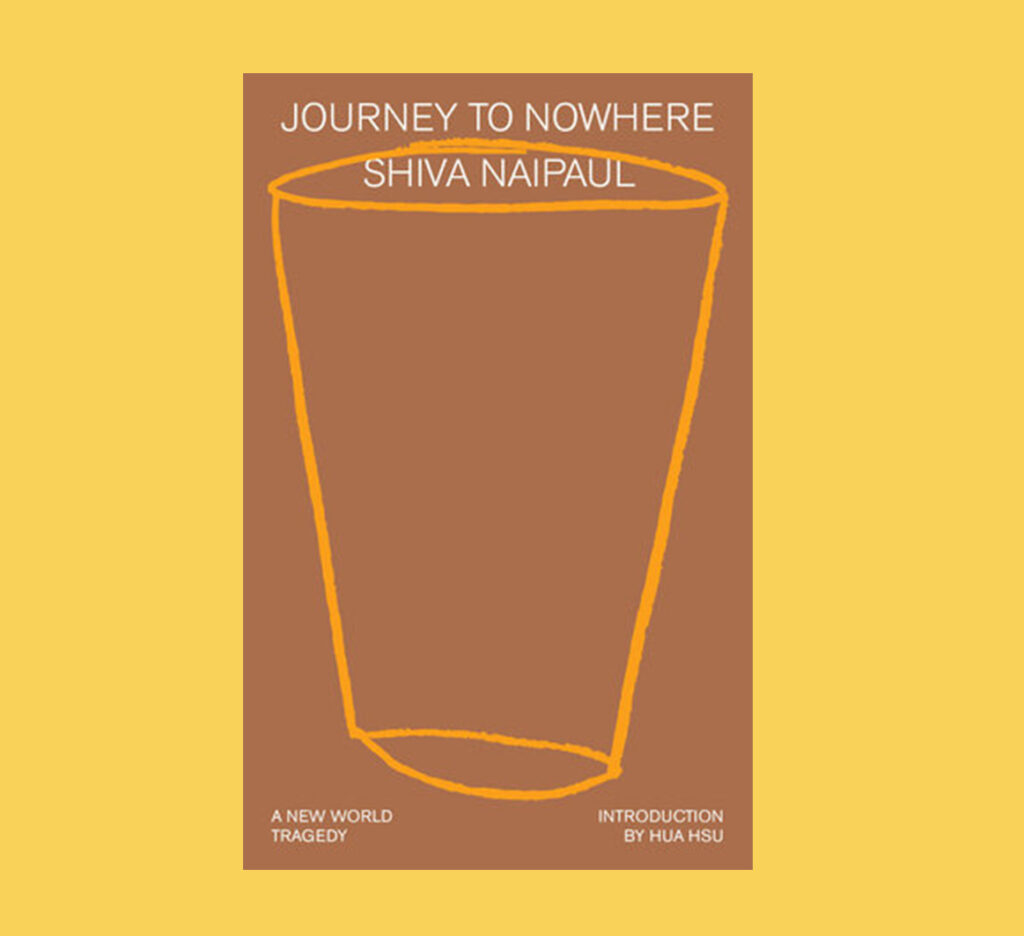
Journey to Nowhere by Shiva Naipaul. Outsider Editions.
Out of print for decades, and newly reissued by Outsider Editions, Journey to Nowhere is the crest of Shiva Naipaul’s abbreviated career as a journalist: some of the finest prose one could ever read about one of the bleakest subjects one could ever contemplate. Subsequent scholarship, written with the aid of archival sources, has yielded better books for understanding Jonestown. But there is no better book for understanding Shiva Naipaul, an immense talent and tragic figure whose name has long been associated with phrases like “unjustly overlooked,” “basically forgotten,” and “younger brother.” Journey to Nowhere is a reminder that his investigation into the mystery of Jonestown is inseparable from the conundrum of his own biography, from the void of the career he might have had and the eclipse of the one he did by his Nobelist elder brother. For Naipaul was also, it turns out, something like a late casualty of Jim Jones’s mania.
***
V.S. Naipaul once told the critic Adam Shatz that there are two kinds of writers: writers and missionaries. The latter subordinate themselves to some vision of social uplift—to politics, in a word. The Naipauls understood themselves to serve a higher purpose, free from the alleged distortions of sentiment. Much of the elder’s reporting from Africa and the Middle East, especially, was scornful, ill-informed, and racist by any measure. Yet at its finest, V.S. Naipaul’s journalism brought something new and needed to the rather anodyne genre of travel writing. “I hadn’t realised that you could write about your ancestral country and people with such raw honesty,” Pankaj Mishra told the Guardian about his teenage discovery of Naipaul’s An Area of Darkness (1964), “or that you could so fearlessly expose your own rages and neuroses.”
Journey to Nowhere belongs to the resurgence of Anglophone travel writing in the seventies and eighties that his brother helped inspire—with an investigative, even prosecutorial bent. The last thing the victims at Jonestown needed was another missionary, Naipaul decided. The book’s service, and much of its freshness, lies in its fusion of indignation and irreverence; pungent, observational wit of this grade, trained on such an intense tragedy, is strange to encounter today. We tend to think of cynicism and sympathy as very distant feelings, but the best cynics are like watchdogs. Any question was worth asking, any eminence was worth embarrassing, if another Jonestown might be prevented.
The book’s two-part structure, set first in Guyana and then the U.S., reflects its thesis: the People’s Temple of Jim Jones and the Guyana of President Forbes Burnham that hosted it were animated by similar strains of ideological delusion that compounded into a kind of deranged feedback loop. “It is hardly a cause for astonishment,” he writes, “that the two regimes were drawn to one another.” In Guyana, Naipaul finds an insular country under the thumb of an opportunist with a cult of personality, heavily militarized and secret-policed, embarked on a shaky course of economic development centered around cooperative agriculture. Burnham had been installed by the CIA in the sixties, but a decade later he’d adopted a syncretic mix of Third-Worldism, Marxism-Leninism, and Black Power—all bunk, in Naipaul’s view. Burnham’s promises to build a flourishing, self-reliant economy protected from craven Yankee imperialists mirrored those of Jones to his followers. Accordingly, Guyana was happy to lease People’s Temple a parcel of land in the jungle and receive the exodus of San Francisco faithful.
To Jones, Burnham was one more easy mark—but Naipaul thought it was Burnham’s left-wing politics, more than his opportunism, that made him so. Naipaul, a jaded, part-time resident of the Bay Area, saw a close correspondence between Jones’s brand of messianism and Burnham’s political style of liberatory, socialist anti-imperialism. In each case, salvation was said to be close at hand but enemies were everywhere; only the leader could be trusted. “Jim Jones built his movement on the debris of the sixties,” he writes, “on its frustrations, failures and apostasies.” He gathered people who longed to be saved and found a patron in Burnham, as cunning as he was in guarantees of deliverance.
The American side of the story, meanwhile, is about how Jones exploited sixties militancy and New Age woo-woo to make People’s Temple a serious player in Bay Area politics. At a time when the energies of Black Power, the women’s movement, and gay liberation were finding new expression in the electoral arena, Jones was both a reminder of what true faith looked like—an old-fashioned populist—and a canny operator, capable of mobilizing large numbers of voters for candidates he favored. It’s true that Jones and People’s Temple were feted by the Democratic Party establishment in California. The sitting mayor, George Moscone, may have owed his election victory to Jones’s voter turnout drives (a practice Jones would repeat in Guyana); City Supervisor Harvey Milk had mounted many public defenses of People’s Temple; State assemblyman and future mayor of San Francisco Willie Brown had even considered Jones a friend. Naipaul’s interview with Brown gets him nowhere: “How, I asked, had [Jones] been able to accumulate that kind of power? That, Brown said, was one of the mysteries of the whole business.”
Naipaul’s real scorn, though, is for the radicals who enabled Jones’s rise by hailing him as an authentic revolutionary—figures like the Black Panther leader Huey P. Newton, who offered Jones “moral support” and whose concept of “revolutionary suicide” he warped to fit his own millenarian, homicidal agenda. Naipaul finds Newton in Oakland, many years removed from political relevance and from sobriety. “I suppose we have to be more careful about the sorts of people and organizations we get involved with in the future,” he says.
The writer Farrukh Dhondy, who was friendly with Naipaul in London despite their political differences, pegged Naipaul’s anti-leftism as pure reflex. “His mockery of socialists didn’t seem to derive from any firm commitment to capitalistic or feudalistic principles” Dhondy recalls in his memoir. It “seemed a visceral reaction. It was as though he had inherited the conviction as people of faith or ultra-nationalists do.”
That would go some way toward explaining Naipaul’s disposition in Journey to Nowhere as well the limits of his inquiry. So intently does he focus on Jones and Burnham’s ideological maneuvers that he looks right past the waving hands of the Western Hemisphere’s most storied priesthood of chaos. If Burnham’s political project was as important a precondition for Jonestown as Naipaul insists, might this story hold a lesson, too, about the unintended consequences of CIA meddling in Latin America? Why hold Huey Newton’s feet to the fire, but not also the former CIA director John McCone, who oversaw the Guyana operation? Naipaul missed an incredible opportunity to thicken the plot: McCone came from San Francisco, of all places.
While Naipaul derides the zelaous—particularly the office-class cadre at Jonestown, whose ranks were disproportionately white in this multiracial church—Journey to Nowhere offers little insight into the motivations of average parishioners, most of whom were working class Black Americans. “The real attraction” of People’s Temple, Naipaul argued, came not from the welfare services the church provided but “from the sense of belonging that the Temple provided.” He may be right about that, but he doesn’t delve much deeper, or ask what appealed about the fraternity they found there.
Indeed, at various points the posture Naipaul assumes in Journey to Nowhere recalls what Edward Said once wrote of his brother: the travel writer “unencumbered with much knowledge or information” and “unrestrained by genuine learning or self-education.” Naipaul writes scathingly, for example, of his encounter with a Guyanese man looking to exchange currency—not because of the request, but because of the “completeness of his corruption, his degeneracy,” as Naipaul puts it. “He was an exhalation of the moral decay I could sense all around me. The society had robbed him of his humanity. It allowed virtually no one to be fully human.” A little much.
***
The reporting of Journey to Nowhere appears to have robbed Naipaul of something that he would never recoup. “He was dispirited by the experience,” Paul Theroux has written, “and for a while it rendered him mute. He suffered something akin to a nervous breakdown during the writing of the book.” When Naipaul’s father-in-law suggested that for his next book he return to the lighter, comic tone of his novels, he replied: “How can I? I have walked over the bodies in Jonestown.” This time he wasn’t being melodramatic. On his tour of the site, near the main pavilion where “most of the bodies had lain, piled three or four deep … leaking away into the Guyanese soil,” the stench of putrefaction was still overwhelming. The wooden planks laid as walkways sank and plunged him into human compost up to his ankles.
Naipaul speculated to friends that he would die young, from the same cardiac ailment that killed his father at the age of forty-six. As it happened he lived only until forty, dying from a heart attack in 1985. (“He was a drinking man,” V.S. Naipaul wrote much later, “and I had seen death on his face the previous year, at the funeral of my younger sister.”) Martin Amis declared it a tragedy for English literature, a loss of nothing less than “thirty years of untranscribed, unvarnished genius.”
I don’t think it’s an insult to Shiva Naipaul’s memory to hope that if he had lived, the nascent genius of his early work might have outgrown his cynicism. Something in him would have had to give, so that the chauvinism and despair that are so close to the surface in Journey to Nowhere would not ultimately win out over the curiosity and moral outrage that drove him to write the book in the first place. The Shiva Naipaul who was most alive to sympathy is the one I wish had written ten more books this deft and droll, who I wish was still writing today. (He would be 81.) One of many sad things about this story is that the Shiva Naipaul I am talking about probably died long before his heart attack.
Andrew Holter is a writer and historian, and the editor of the Murray Kempton collection Going Around: Selected Journalism (Seven Stories Press). His work has appeared in The Baffler, Boston Review, The Nation, Rolling Stone, The Times Literary Supplement, Places Journal, and The Drift, among others.
 Log in