engineer, actor, intellectual, mal vivant
495 stories
·
102 followers

No More Missionaries: Shiva Naipaul’s Jonestown

1 Share

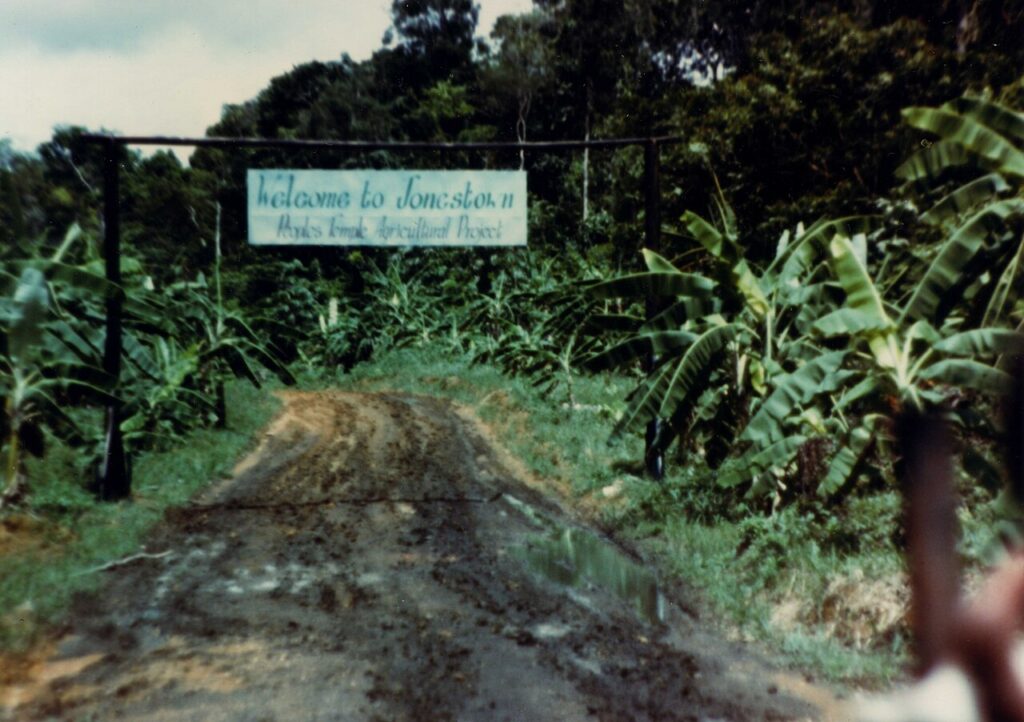
Courtesy of The Jonestown Institute at San Diego State University, via Wikimedia Commons.

From the outset there seemed to be little mystery as to the facts of the case at Jonestown. The victims included over nine hundred men, women, and children of People’s Temple, the majority of them Black Americans from the San Francisco Bay Area (which matters). The scene of the crime was an agricultural commune in the South American nation of Guyana (not a coincidence). The murder weapon (the word “suicide” here would be imprecise) was a blend of poisons mixed into a powdered drink called Fla-Vor-Aid. The culprit was the Reverend Jim Jones and his motive was simple: to spare his flock their impending annihilation at the hands of the United States government. Jones had talked about this prospect incessantly, obsessively, for a long time. There had been rehearsals.

If the question is why so many people decided to kill themselves, the first answer has to be that a lot of them didn’t. Many syringes were found at the scene among the plastic cups. There was no meaningful notion of choice at Jonestown; Jones’s command to take the poison was enforced by men with guns. A third of the victims were children. Atrocities of that scale tend to have world-historic causes. But in the aftermath of that awful night on November 18, 1978, public inquiries mostly focused on the morbid explanations (cultology, groupthink, leader-worship, etc). Whatever else Jonestown was, it was the result of an accretion of human choices, many of them rational, and yet few writers investigated the political circumstances that had allowed a mad cleric to assume such earthly power in the first place.

It was this possibility—that Jonestown was best understood as a vast political catastrophe—that most interested Shiva Naipaul. Younger brother of the better-known Vidiadhar Surajprasad (V.S.), Naipaul was quick to see in Jonestown a story about much more than a cult. In the weeks and months after November 18, he observed, no one who had supported Jones and People’s Temple from afar had accepted any degree of responsibility.    

Journey to Nowhere: A New World Tragedy, Naipaul’s contemptuous postmortem of Jonestown first published in 1982, was different from the tawdry exposés of the journalists, entrepreneurs, and former Jones-followers who rushed to sign book contracts before the corpses had even been buried. Then in his mid-thirties, Naipaul was Indian from Trinidad, who knew that part of the Caribbean. He was also a writer of fiction rather than conventional reportage. But Journey to Nowhere’s greatest divergence from the Jonestown canon is the degree to which its narrative is propelled by its author’s sense of moral outrage. Naipaul is less concerned with the fates of the victims than the ideas that fed the perpetrators—not all of whom, he believed, perished in Guyana. The result is a little masterpiece of skeptical inquest, as virtuosic as H.L. Mencken on religious fanatics and fraudsters of the twenties, but ill at ease from its very first sentence: “At Piarco Airport in Trinidad, I nearly jumped ship.” 
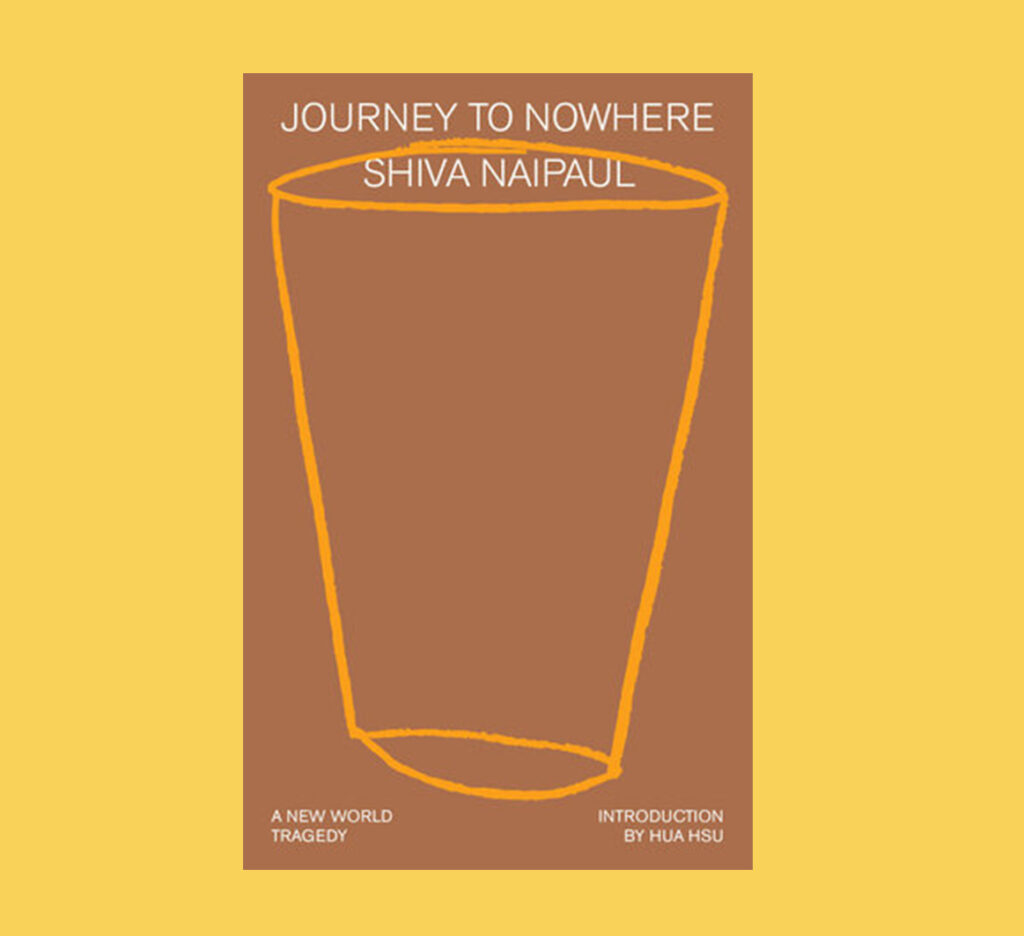
Journey to Nowhere by Shiva Naipaul. Outsider Editions.

Out of print for decades, and newly reissued by Outsider Editions, Journey to Nowhere is the crest of Shiva Naipaul’s abbreviated career as a journalist: some of the finest prose one could ever read about one of the bleakest subjects one could ever contemplate. Subsequent scholarship, written with the aid of archival sources, has yielded better books for understanding Jonestown. But there is no better book for understanding Shiva Naipaul, an immense talent and tragic figure whose name has long been associated with phrases like “unjustly overlooked,” “basically forgotten,” and “younger brother.” Journey to Nowhere is a reminder that his investigation into the mystery of Jonestown is inseparable from the conundrum of his own biography, from the void of the career he might have had and the eclipse of the one he did by his Nobelist elder brother. For Naipaul was also, it turns out, something like a late casualty of Jim Jones’s mania. 

***

V.S. Naipaul once told the critic Adam Shatz that there are two kinds of writers: writers and missionaries. The latter subordinate themselves to some vision of social uplift—to politics, in a word. The Naipauls understood themselves to serve a higher purpose, free from the alleged distortions of sentiment. Much of the elder’s reporting from Africa and the Middle East, especially, was scornful, ill-informed, and racist by any measure. Yet at its finest, V.S. Naipaul’s journalism brought something new and needed to the rather anodyne genre of travel writing. “I hadn’t realised that you could write about your ancestral country and people with such raw honesty,” Pankaj Mishra told the Guardian about his teenage discovery of Naipaul’s An Area of Darkness (1964), “or that you could so fearlessly expose your own rages and neuroses.” 

Journey to Nowhere belongs to the resurgence of Anglophone travel writing in the seventies and eighties that his brother helped inspire—with an investigative, even prosecutorial bent. The last thing the victims at Jonestown needed was another missionary, Naipaul decided. The book’s service, and much of its freshness, lies in its fusion of indignation and irreverence; pungent, observational wit of this grade, trained on such an intense tragedy, is strange to encounter today. We tend to think of cynicism and sympathy as very distant feelings, but the best cynics are like watchdogs. Any question was worth asking, any eminence was worth embarrassing, if another Jonestown might be prevented.

The book’s two-part structure, set first in Guyana and then the U.S., reflects its thesis: the People’s Temple of Jim Jones and the Guyana of President Forbes Burnham that hosted it were animated by similar strains of ideological delusion that compounded into a kind of deranged feedback loop. “It is hardly a cause for astonishment,” he writes, “that the two regimes were drawn to one another.” In Guyana, Naipaul finds an insular country under the thumb of an opportunist with a cult of personality, heavily militarized and secret-policed, embarked on a shaky course of economic development centered around cooperative agriculture. Burnham had been installed by the CIA in the sixties, but a decade later he’d adopted a syncretic mix of Third-Worldism, Marxism-Leninism, and Black Power—all bunk, in Naipaul’s view. Burnham’s promises to build a flourishing, self-reliant economy protected from craven Yankee imperialists mirrored those of Jones to his followers. Accordingly, Guyana was happy to lease People’s Temple a parcel of land in the jungle and receive the exodus of San Francisco faithful.

To Jones, Burnham was one more easy mark—but Naipaul thought it was Burnham’s left-wing politics, more than his opportunism, that made him so. Naipaul, a jaded, part-time resident of the Bay Area, saw a close correspondence between Jones’s brand of messianism and Burnham’s political style of liberatory, socialist anti-imperialism. In each case, salvation was said to be close at hand but enemies were everywhere; only the leader could be trusted. “Jim Jones built his movement on the debris of the sixties,” he writes, “on its frustrations, failures and apostasies.” He gathered people who longed to be saved and found a patron in Burnham, as cunning as he was in guarantees of deliverance.  

The American side of the story, meanwhile, is about how Jones exploited sixties militancy and New Age woo-woo to make People’s Temple a serious player in Bay Area politics. At a time when the energies of Black Power, the women’s movement, and gay liberation were finding new expression in the electoral arena, Jones was both a reminder of what true faith looked like—an old-fashioned populist—and a canny operator, capable of mobilizing large numbers of voters for candidates he favored. It’s true that Jones and People’s Temple were feted by the Democratic Party establishment in California. The sitting mayor, George Moscone, may have owed his election victory to Jones’s voter turnout drives (a practice Jones would repeat in Guyana); City Supervisor Harvey Milk had mounted many public defenses of People’s Temple; State assemblyman and future mayor of San Francisco Willie Brown had even considered Jones a friend. Naipaul’s interview with Brown gets him nowhere: “How, I asked, had [Jones] been able to accumulate that kind of power? That, Brown said, was one of the mysteries of the whole business.”

Naipaul’s real scorn, though, is for the radicals who enabled Jones’s rise by hailing him as an authentic revolutionary—figures like the Black Panther leader Huey P. Newton, who offered Jones “moral support” and whose concept of “revolutionary suicide” he warped to fit his own millenarian, homicidal agenda. Naipaul finds Newton in Oakland, many years removed from political relevance and from sobriety. “I suppose we have to be more careful about the sorts of people and organizations we get involved with in the future,” he says.  

The writer Farrukh Dhondy, who was friendly with Naipaul in London despite their political differences, pegged Naipaul’s anti-leftism as pure reflex. “His mockery of socialists didn’t seem to derive from any firm commitment to capitalistic or feudalistic principles” Dhondy recalls in his memoir. It “seemed a visceral reaction. It was as though he had inherited the conviction as people of faith or ultra-nationalists do.”

That would go some way toward explaining Naipaul’s disposition in Journey to Nowhere as well the limits of his inquiry. So intently does he focus on Jones and Burnham’s ideological maneuvers that he looks right past the waving hands of the Western Hemisphere’s most storied priesthood of chaos. If Burnham’s political project was as important a precondition for Jonestown as Naipaul insists, might this story hold a lesson, too, about the unintended consequences of CIA meddling in Latin America? Why hold Huey Newton’s feet to the fire, but not also the former CIA director John McCone, who oversaw the Guyana operation? Naipaul missed an incredible opportunity to thicken the plot: McCone came from San Francisco, of all places.

While Naipaul derides the zelaous—particularly the office-class cadre at Jonestown, whose ranks were disproportionately white in this multiracial church—Journey to Nowhere offers little insight into the motivations of average parishioners, most of whom were working class Black Americans. “The real attraction” of People’s Temple, Naipaul argued, came not from the welfare services the church provided but “from the sense of belonging that the Temple provided.” He may be right about that, but he doesn’t delve much deeper, or ask what appealed about the fraternity they found there. 

Indeed, at various points the posture Naipaul assumes in Journey to Nowhere recalls what Edward Said once wrote of his brother: the travel writer “unencumbered with much knowledge or information” and “unrestrained by genuine learning or self-education.” Naipaul writes scathingly, for example, of his encounter with a Guyanese man looking to exchange currency—not because of the request, but because of the “completeness of his corruption, his degeneracy,” as Naipaul puts it. “He was an exhalation of the moral decay I could sense all around me. The society had robbed him of his humanity. It allowed virtually no one to be fully human.” A little much.

***

The reporting of Journey to Nowhere appears to have robbed Naipaul of something that he would never recoup. “He was dispirited by the experience,” Paul Theroux has written, “and for a while it rendered him mute. He suffered something akin to a nervous breakdown during the writing of the book.” When Naipaul’s father-in-law suggested that for his next book he return to the lighter, comic tone of his novels, he replied: “How can I? I have walked over the bodies in Jonestown.” This time he wasn’t being melodramatic. On his tour of the site, near the main pavilion where “most of the bodies had lain, piled three or four deep … leaking away into the Guyanese soil,” the stench of putrefaction was still overwhelming. The wooden planks laid as walkways sank and plunged him into human compost up to his ankles.

Naipaul speculated to friends that he would die young, from the same cardiac ailment that killed his father at the age of forty-six. As it happened he lived only until forty, dying from a heart attack in 1985. (“He was a drinking man,” V.S. Naipaul wrote much later, “and I had seen death on his face the previous year, at the funeral of my younger sister.”) Martin Amis declared it a tragedy for English literature, a loss of nothing less than “thirty years of untranscribed, unvarnished genius.”

I don’t think it’s an insult to Shiva Naipaul’s memory to hope that if he had lived, the nascent genius of his early work might have outgrown his cynicism. Something in him would have had to give, so that the chauvinism and despair that are so close to the surface in Journey to Nowhere would not ultimately win out over the curiosity and moral outrage that drove him to write the book in the first place. The Shiva Naipaul who was most alive to sympathy is the one I wish had written ten more books this deft and droll, who I wish was still writing today. (He would be 81.) One of many sad things about this story is that the Shiva Naipaul I am talking about probably died long before his heart attack.


Andrew Holter is a writer and historian, and the editor of the Murray Kempton collection Going Around: Selected Journalism (Seven Stories Press). His work has appeared in The Baffler, Boston Review, The Nation, Rolling Stone, The Times Literary Supplement, Places Journal, and The Drift, among others.

Read the whole story
fancycwabs
12 hours ago
reply
Nashville, Tennessee
Share this story
Delete

Drifting SpaceX rocket heading for accidental collision with moon | SpaceX | The Guardian

2 Comments

A drifting SpaceX rocket is on a collision course with the moon after launching a pair of lunar landers more than a year ago.

The rocket’s upper stage will unintentionally slam into the moon on Wednesday, carving out a crater and sending up a plume of dust and rubble that scientists – and sky gazers – are eager to observe.

Space tracking expert Bill Gray predicts an impact of 5,400mph (8,700km/h) – seven times the speed of sound – near Einstein Crater on the moon’s sunlit western limb. With the action unfolding in the wee hours of the morning for the US, the eastern portions of the US and Canada, and much of South America, should have the best views.

While scientists are not too concerned about this particular piece of space junk, it highlights the growing threat as more and more items cram into orbit.

“Things are getting crowded up there,” said Gray, who plans to view the aftermath from New Brunswick, Canada.

It was never SpaceX’s intent to hit the moon. But space experts said the crash could have been avoided if the upper stage had been nudged into orbit around the sun.

It will be the second dead rocket known to crash into the moon accidentally. A Chinese rocket segment dug out a pair of craters on the lunar far side in 2022.

The new smashup will occur on the moon’s near side, packing the equivalent energy of three tons of TNT explosives.

The impact flash, lasting less than a second, will probably be too dim to see from Earth, according to experts. But the stream of ejected material could stretch for several miles into space and remain visible to telescopes for tens of minutes.

“Gravity on the moon is low and there is no wind to blow the dust away,” said Los Alamos national laboratory’s Benjamin Fernando, who is encouraging observations by professionals and amateurs alike.

“Part of the reason for our interest in this event is to figure out how much of a hazard debris impacts pose to future astronauts,” he added in an email.

Fernando anticipates an impact crater nearly 90ft across and 16ft deep (27 meters across and 5 meters deep), too small to see from Earth but visible to spacecraft.

Nasa’s Lunar Reconnaissance Orbiter and South Korea’s Danuri lunar orbiter will gather before-and-after shots of the crash scene.

Read the whole story
fancycwabs
7 days ago
reply
I can only assume he was trying to blow the Webb space telescope out of the sky and missed.
Nashville, Tennessee
Share this story
Delete
1 public comment
sarcozona
7 days ago
reply
Cool, trashing the moon now
Epiphyte City

The Bit Player: My Father with Steve Zissou

1 Share

Photograph courtesy of Molly Cooper.

In the mideighties, at my mother’s insistence, my father started seeing a psychoanalyst named Dr. Stein, who had an office on East Ninety-Sixth Street. I was around nine or ten, and could reliably be found camped out on the carpet in front of our family television, recording or rewatching scenes from my favorite shows, or poring over the latest issues of Teen Beat and Bop, a pair of nail scissors handy to clip out celebrity photos for my bedroom walls. I don’t remember much of what my father said when he’d occasionally mention his visits to Dr. Stein, but one detail that stuck was that he sometimes rode up or down in the elevator with Bill Murray, who happened to live in the building. 

I’m not sure who said it, most likely my mother, but the idea was floated that they resembled each other, my father and Bill. Both were tall, of medium build, with soft, rounded features, blue eyes, wavy brown hair (fair to say somewhat disheveled), and a wry, ready grin. In this comparison, to my young ears at least, there was a sense of something appropriate, even fated perhaps, about these elevator encounters.

At the time, my father was a staff writer at The New Yorker, where he had spent much of the previous two decades covering the Apollo missions and the space voyages that followed. The job, he often said, was the only one he’d ever wanted. As a child growing up in post-Depression New York City, he had been captivated by Jules Verne’s From the Earth to the Moon, which had ushered in a lifelong fascination with space exploration. As a teenager, he had set his sights on The New Yorker and—after cutting his teeth at his college paper, a mandated stint in the army, and a few frustrated months idling in journalism school—he finally caught the attention of its editor. 

Some of his reverence for the magazine inevitably filtered down to me, and I can remember my excitement each week when the latest issue would land on our hallway mail table with FIRST RUN COPY printed across the front. Or the night when, celebrating my father’s fiftieth birthday, a crowd of his colleagues flooded our narrow dining room, cutting into a large chocolate cake topped with a miniature plastic spaceship and fleet of tiny spacemen touching down on a soft vanilla crust. 

***

After I graduated from college, lacking my father’s clear sense of mission, I found myself in Los Angeles, with no real purpose in mind other than to put some distance between myself and the places I knew. I rented a house with two friends: an uninsulated, single-story bungalow with a cement front yard and a broken trampoline in the back. And I took a string of freelance reading and research jobs, in distant service of the film industry. 

By this time, my father’s luck had begun to falter. The national interest in space travel had been on a steady decline since the Challenger disaster, and in the midnineties, he was let go from The New Yorker. He wrote occasionally for other publications, but eventually he found himself slipping into an early and unwanted retirement.

Then, one late-spring morning around the turn of the millennium, a day after he broke his leg in a pothole while running to catch a cab, my mother filed for divorce. Their marriage had never been a good one, but in its later years, they had settled into what felt like a comfortable sort of détente, so the move came as a surprise to everyone, perhaps my father most of all. He lingered in the apartment that summer and fall, until Thanksgiving morning, when my mother finally reached her limit. After that, he moved into a one-bedroom, ate defrosted chicken pot pies for dinner most nights, and learned to do laundry for the first time.

In those early years after the separation, he came out to California to visit me often. We took trips up the coast to Hearst Castle, south to Catalina, and east to Palm Springs, two native New Yorkers shrinking from the sun. I am the youngest of my siblings and had sometimes felt like a bit of an afterthought, so these trips offered a chance to get to know a person who had always seemed just slightly out of reach. 

***

At some point during this time, I started to find more steady film work. After a year spent assisting a young producer in Beverly Hills, I was offered a job by a more established producer named Barry Mendel, who had an office on the Universal Studios Lot. Mendel had recently produced Wes Anderson’s Rushmore and The Royal Tenenbaums, and in the summer of 2002, when I started working for him, he was getting ready to make his third project with Anderson, The Life Aquatic with Steve Zissou. The script, cowritten by Anderson and Noah Baumbach, tells the story of an aging oceanographer, the eponymous Zissou, who sets out, after a series of failures, on what is probably his final expedition—an ill-fated voyage to exact revenge on the mythical shark responsible for killing his best friend. 

The following summer, I flew from Los Angeles to Italy, where the film was to be shot. The production was based at Cinecittà Studios, on the outskirts of Rome, a sprawling compound built just before World War II, which served as a location for Ben-Hur and Roman Holiday, as well as many classics of twentieth-century Italian cinema. My desk was in the production department, on the second floor of Stage 15, next to the spaces where we were to do much of our indoor filming. I shared an office with a quiet Italian woman whose nickname was Mouse, and as preproduction got underway, I spent most of my days running errands, rolling calls for Mendel, and schooling myself in the details of film budgets and schedules. Sometimes I’d visit the art workshops, where I could see the costumes and props in their various phases of completion. On my way up to my desk, I could hover just inside the door of a soundstage while painters and carpenters worked at their tasks, watching the sets slowly rise. 

My new colleagues and I met up for dinner most nights, sitting outside in the stifling heat on cobblestoned streets, and on weekend afternoons searched for movie theaters playing American films with their original English dialogue, subtitled and not dubbed. I had recently bought my first iPod, and on weekend mornings, I would walk from my small, top-floor apartment on the Via Giulia up to the Borghese Gardens, listening to the Smashing Pumpkins’ “1979” on repeat, reveling in my unimaginable good luck. 

The actors weren’t there yet, but they had been cast and were due to start arriving soon. The main roles would be played by Cate Blanchett plus a few Anderson regulars: Owen Wilson, Anjelica Huston, Seymour Cassel, and, in the role of Steve Zissou, Bill Murray.

***

Photograph courtesy of Molly Cooper.

At the tail end of the summer, just before production was set to begin, my father came for a visit. He arrived in time for a weekend, and we spent two hot days wandering around the old Roman Forum, climbing the narrow stairwell in the dome of Saint Peter’s, and sitting on the Spanish Steps to take in the crowds. His leg hadn’t fully healed, and I noticed he was a little less sure on his feet, often needing to stop for a rest.

On Sunday evening, just as we were finishing dinner, my cellphone rang. It was a friend from the production. He explained that an actor who had flown in from New York to play a small role had gotten sick, and the casting office was having trouble finding a replacement. Someone remembered that my dad was in town—he was roughly the right age and, more importantly, a native speaker of English. No matter if he hadn’t acted before. Would he be willing to come in for a screen test?

I asked my friend if he was joking—it wouldn’t have been entirely out of character—but he wasn’t. And so, with a degree of ambivalence, I promised I would ask. 

The following morning, my father, half-amused and half-curious, with a helpfully open schedule and low expectations, took a taxi to the casting studio. Never noted for his acting talent, he fumbled his way through the reading, misdelivering the lines. But something—perhaps his distinctive manner of speaking, an unplaceable, mid-Atlantic lockjaw, or some element of his signature tatty style—must have bespoke potential. Or maybe they really were just out of options. The next thing I knew, the costume department was asking me for his shoe size.

His scene was scheduled to be filmed less than forty-eight hours later, on the first official day of the shoot. The script would be delivered to his hotel, but given the tight turnaround, there would be no time for advance fittings or rehearsals. A few test shots had been filmed, but this was the first day on which formal reports and footage would be sent back to the executives in Los Angeles—the start of an ambitious, monthslong slog. A mood of harried anticipation was in the air.

***

Early on the morning of the shoot, I picked up my father from his hotel. Anxiety is a thread that weaves through my family, binding us all. I can vividly remember my mother clutching the hands of strange men on airplanes, her palms drenched in sweat, as we weathered minor turbulence. Once, she tried to refuse a community-service award because she didn’t want to appear onstage to collect it. 

My father, always preternaturally comfortable at social gatherings, struggled with anything resembling a real stage, and as he got into the car that morning, he announced that he felt like a lamb going to slaughter. Since childhood, he had contended with an intermittent stutter, which often presented as a sort of boarding school affect held over from his youth. But it became more vexing when he was nervous, and as we made our way down the winding streets of central Rome toward the larger thoroughfares leading to Cinecittà, I could hear it starting to surface.

I dropped him off at the costume department and headed back to my office. His scene was first on the schedule, set to shoot right after lunch. In it, he was to play a television talk-show host interviewing Zissou and his crewmate, played by Seymour Cassel. The scene was short, consisting of only a brief exchange: my father, as the interviewer, was to ask a question; then Bill Murray was to shrug, and Cassel would give a one-line response. 

On my way up to my desk, I stopped in at the soundstage. At the far end of the vast space, a small set had been erected: a faux television stage, midcentury in style and outfitted in shades of orange and brown. In the middle, flanking a low, lacquered coffee table, were three tawny, padded swivel chairs, casually awaiting their occupants.

Around lunchtime, I went to look for my father and found him sitting in a makeup chair in front of a bank of theater mirrors. His navy-blue blazer and scuffed Rockports had been traded for a roomy Italian suit, dove gray with white pinstripes, and sleek, honey-colored dress shoes. A white tissue had been fixed under his glasses to shield them from the buff makeup coating his face, and a stylist was coiffing his hair. It was hard to talk much amid these ministrations, but even in our brief exchange he imparted an air of deep dismay.

Just as I was getting back to my desk, the phone rang. The voice was familiar: it was Bill Murray, and he had a question. He had known Anderson to cast people with no previous acting experience. He had worked with some of these people in the past.

“Has your father ever acted before?” he asked. His tone sounded somewhere between amused and alarmed. 

I explained, regretfully, that he had not.

There was silence, followed by a long sigh. 

***

The overhead lights had been switched off, and the little set was aglow in the middle of the room. The crew were crowding around, attending to finishing touches or waiting astride apple boxes. The three cast members arrived, led in by a team of production assistants, and took their places on the set. 

In the decade or two since they had stood side by side in an elevator, my father and Murray had stopped resembling each other, if they ever really had. In his pale blue oceanographer’s suit, Murray looked healthy, tanned, robust; his hair dyed blond for the role, his beard cut neat, he appeared patently self-assured. My father, in comparison, looked small and tired up on stage, his mouth fixed in a half smile, the bright lights drawing attention to his thinning hairline and shiny skin (another shared family trait).

The room quieted, and Anderson, in a tan suit and Wallabees, moved toward the set and began running through the scene. My father was first: he started in on his line but then abruptly stopped, realizing he’d mixed up two names. He announced his mistake, and Anderson gently prompted him to try again. This time, he made it through the first part of the line but forgot the second. On his third try, the words were right but the rhythm was off. This pattern continued: a name wrong, a phrase left out, the cadence not quite there. A few times, Cassel, fresh off a plane and jet-lagged, botched his delivery. But mostly the errors were my dad’s. Murray sat in the middle, arms folded, a look of mild exasperation on his face.

Finally, Anderson started rolling the camera, and I moved to the back of the room, far from the stage lights, where I walked in circles on the concrete floor, listening uneasily as the takes began to pile up. The minutes slid by, soon approaching an hour. Eventually, during a momentary reset, I slipped quietly out the stage door.

***

My father, whose natural good humor gave rise to a generous wit, had a knack for telling stories. Once back home in New York, he didn’t just dine out on this one, he feasted. He had found his new subject, and no audience was wrong. He wrote up a version of the events, playing up the gaffes, casting himself as the guileless ingenue and me as the loyal agent, and published it in his college alumni magazine. He rechristened his pontoon boat, formerly The Summer Squash, in honor of the film, commissioning a colorful wooden sign to herald its new name: The Life Aquatic. On his mantelpiece, he placed a fake Oscar gifted by a friend and a series of framed photographs from the shoot, and these items would elicit further retellings anytime a new person came for a visit: “Have I told you about my star turn?” It didn’t matter if he already had. There was always some new spin he could put on it. 

At the time, this repurposing of the narrative puzzled me. It might have been the scaling up, the way in which a brief and awkward event had been granted such exalted proportions. But looking back, I think I understand it better. As much as the experience stirred something in me, it clearly stirred something deeper in him. 

Late in The Life Aquatic, Zissou laments, “I haven’t been at my best this past decade.” The film is technically a comedy, but a wistfulness lies at its core. The death of Zissou’s best friend, Esteban, begins the story, and the losses continue to mount from there: Zissou’s wife, Eleanor, walks out on him, and he later loses his professional credibility, along with some of his crew.  In one of the film’s final scenes, staring out the window of his minisub at the elusive jaguar shark, Zissou begins to cry. A moment later, he reaches out to touch the belly of the pregnant reporter sitting at his side. She responds by saying, “In twelve years, he’ll be eleven and a half.” A smile emerges through Zissou’s tears. He professes, “That was my favorite age.”

In a way, despite the apparent randomness of all the preceding events, it seems possible to argue that my father’s casting was appropriate—even fated. The role he played, a late mid-century reporter tasked with interviewing a pair of scientific adventurers, wasn’t so far from his lived reality. Then again, neither was the story of the film’s main character, a man pushing late middle-age, a bit bruised but still up for one last spin.

***

I flew back to Los Angeles at the end of the shoot, and a few months later, I put in my notice, packed what few belongings I had acquired in my four years on the West Coast, and made my way back to New York. I worked on several more films in the following years, but my father was never cast again. In 2016, he died.

My sisters and I had often talked about putting him on tape, recording some of his best stories for posterity, but as sometimes happens with such plans, we never got around to it. In the end, the only recording I have of him is this scene, an eight-second clip, cut into the middle of a busy party montage, in which he briefly leans forward across an old tube-television screen and delivers the correct, final version of his line: “People say Eleanor is the brains behind Team Zissou. What is Steve?”


Molly Cooper is a film producer and writer.
Read the whole story
fancycwabs
11 days ago
reply
Nashville, Tennessee
Share this story
Delete

DOD Changes Number of Iran War Casualties to Make Trump Look Better

1 Comment and 2 Shares

The Department of Defense has changed the official number of U.S. military service members killed in the war with Iran from 18 to 14—and couldn’t explain why.

Three military officials told The New York Times Thursday that one reason the death toll had been altered was because four of the deaths occurred last week, after President Donald Trump’s ceasefire fell apart. The Trump administration has previously tried to insist that there are two separate phases in the war effort.

Meanwhile, Joel Valdez, the acting press secretary for the Pentagon, told the outlet that the change resulted from “temporary data disruptions” and would soon be fixed.

The DOD has argued that it is bound by law to report on deaths, but not injuries. But here, the Pentagon’s shady actions highlight the startling lack of transparency as Trump continues to prosecute his wildly unpopular war with Iran.

The Pentagon has been slow to release information about U.S. service members’ conditions, and has downplayed the extent of their injuries.

The DOD also withheld information about three Iranian strikes last week that injured dozens of U.S. service members and damaged several helicopters, U.S. officials told the Times.

Earlier this year, Defense Secretary Pete Hegseth referred to an Iranian drone strike on a makeshift tactical operations center in Kuwait as a “squirter.” But dozens of U.S. service members suffered from injuries including burns, shrapnel wounds, and brain trauma. The Pentagon, however, did not release information about how many were hurt in the strike, and U.S. Central Command initially claimed that just five were seriously wounded.


Read the whole story
fancycwabs
14 days ago
reply
The casualty numbers went way down after Trump ordered that they shouldn't include "suckers and losers."
Nashville, Tennessee
Share this story
Delete

Expedition captures first images of Shackleton's last ship

2 Shares

Back in 2024, we reported on the discovery of the Quest shipwreck, the polar exploration vessel that served Arctic explorer Sir Ernest Shackleton on his last voyage. Shackleton died before reaching their destination, and the ship itself sank in 1962. The Royal Canadian Geographic Society (RCGS) has now released the first images of the wreck more than 60 years after it sank, published in Canadian Geographic magazine.

Shackleton, of course, is most famous for his ill-fated voyage on the Endurance, which became trapped in sea ice in 1914 and sank. Shackleton and his crew defied the odds and survived. (The Endurance shipwreck was finally found in 2022.) By the time Shackleton got back to England, the country was embroiled in World War I, and many of his men enlisted. Shackleton was considered too old for active service. He was also deeply in debt from the Endurance expedition, earning a living on the lecture circuit. But he still dreamed of making another expedition to the Arctic Ocean north of Alaska to explore the Beaufort Sea. He got funding from an old school chum, John Quillier Rowett.

Shackleton purchased a wooden Norwegian whaler, Foca I, which his wife Emily renamed Quest. When the Canadian government withdrew its support, the mission shifted back to the Antarctic, and the Quest received an extensive retrofit. The improvements included a new deckhouse, a heated crow’s nest, a wireless set, and an odograph for tracing and charting the route automatically, as well as a Lucas deep-sea sounding machine, a large and pricey collection of cameras and photographic equipment, and even a small airplane.

The Quest expedition to Antarctica set sail in 1921. Shackleton never reached the planned destination, falling ill in late December just as the ship was about to leave Rio de Janeiro, Brazil. He had begun drinking heavily to “deaden the pain,” despite not usually allowing alcohol while at sea. The Quest reached south Georgia on January 4, 1922, and Shackleton made his final diary entry before retiring to bed.

Ernest Shackleton died on board the Quest in 1922. Forty years later, the ship sank off Canada's Atlantic Coast.
Ernest Shackleton died on board the Quest in 1922. Forty years later, the ship sank off Canada's Atlantic Coast. Credit: Tore Topp/Royal Canadian Geographi
Sonar image showing the wreck of the Quest in the Labrador Sea.
Sonar image showing the wreck of the Quest in the Labrador Sea. Credit: Canadian Geographic

By 2 am, he was complaining of back pains and requesting painkillers. Ship physician Alexander Macklin suggested Shackleton might try leading a more normal life. Shackleton asked what Macklin thought he should give up. “Chiefly alcohol, boss, I don’t think it agrees with you,” the physician replied. Then Shackleton “had a very severe paroxysm” and died. The official recorded cause of death was coronary thrombosis. His body was buried in a Norwegian cemetery in Grytviken, the grave marked by a rough cross (later replaced by a granite column).

The expedition was cut short. There were a few scientific papers that came out of the journey and some useful geological and survey work, but on the whole, the expedition’s accomplishments were minor.

The ship was retrofitted a couple more times over its existence. It was used in several other expeditions in the 1930s and on various rescue missions. Quest served in the Royal Canadian Navy during World War II as a minesweeper and light cargo vessel and returned to commercial sealing operations after the war. It was on one such seal-hunting expedition on May 5, 1962, when the plucky little ship was pierced by ice and sank—the same damage suffered by Endurance decades before. And like the Endurance, her entire crew survived.

A thriving ecosystem

Credit: YouTube/Canadian Geographic

The RCGS led the effort to locate the wreckage, investing some $365,000 in the project. CEO John Geiger spearheaded the search, which initially involved scouring through ship’s logs, navigation records, and other documents. The 23 crew members fought through dense fog and dealt with equipment issues after leaving port on June 5. But their patience was rewarded after 17 hours of scanning the ocean floor with sonar: Geiger spotted an odd shape pop onto his screen that was unmistakably the Quest.

This latest mission, with the Woods Hole Oceanographic Institute (WHOI) as a partner, relied on a Falcon remote-operated vehicle and an ALVIN deep submergence vehicle to explore the wreck site further, launching on July 2. These are just the first images; more will be forthcoming. The team ultimately plans to create a 3D digital twin of the wreck site using underwater photogrammetry technology.

Initial sonar images back in 2024 gave the team hope about the overall condition of the ship. These new images, however, revealed that Quest is in worse condition than previously thought, with fishing nets, floats, and other bottom trawling gear snagged on the stern and much of the starboard side. The bridge superstructure is missing entirely, although the aluminum bridge is still attached. Expedition research director Antoine Normandin was disappointed at first, but then realized that "Quest itself is now becoming a science experiment," he told Canadian Geographic.

WHOI biologist Kirstin Meyer-Kaiser told Canadian Geographic that the Quest shipwreck has been transformed into a thriving underwater ecosystem. The surviving structures and materials are now host to various marine life: soft corals clustered around the top of the bow, for example, and threatened species such as the spotted wolffish. “It’s really cool to me that the impact of human history is that we’re creating a habitat," she said. "We’re increasing biodiversity on the local scale of the wreck, and maybe also on the regional scale because now it’s a stepping stone for some of those things to spread.”

Read full article

Comments


Read the whole story
fancycwabs
25 days ago
reply
Nashville, Tennessee
fxer
27 days ago
reply
Bend, Oregon
Share this story
Delete

Even Valve Knows You May Be Better Off With a Cheaper Steam Machine Alternative

1 Comment
Valve may make PC gaming better, so long as you don't mind installing SteamOS yourself.

Read the whole story
fancycwabs
45 days ago
reply
It's telling that they're charging $1000+ and showing a game that plays perfectly well on a $300 iPad or a $250 Nintendo Switch.
Nashville, Tennessee
Share this story
Delete
Next Page of Stories